
 English

Our team is committed to providing high-performance energy solutions tailored to your needs. To initiate further communication, kindly submit a formal inquiry for the product(s) of your interest.



Our team is committed to providing high-performance energy solutions tailored to your needs. To initiate further communication, kindly submit a formal inquiry for the product(s) of your interest.
Upgrading a golf cart from lead acid to lithium is one of the most noticeable improvements an owner can make: lighter, faster to charge, no more water topping, and noticeably more range on the same cart. But the market is full of packs with impressive capacity numbers and very different real-world behaviour, so choosing the best lithium battery for a golf cart takes more than comparing amp-hours.
Confirm the Voltage First
Golf carts are built around a fixed system voltage, and getting this wrong makes the rest of the comparison meaningless. Match the pack to your cart:
· 36V carts — the older, smaller fleet and utility carts; a 38.4V nominal LiFePO4 pack replaces six 6V lead acid units.
· 48V carts — by far the most common modern standard, from Club Car, EZGO and Yamaha four-seaters to lifted off-road builds; a nominal 51.2V LiFePO4 pack is a direct replacement for four 12V or six 8V lead acid units.
· 72V carts — high-speed and heavy-load off-road buggies; use two matched 36V packs in series or a purpose-built 72V pack.
Never mix voltages or brands inside one cart. If your cart has a factory 48V controller and motor, stay at 48V: raising the voltage without changing the controller and motor can damage the drive system and void its warranty.
Match Capacity to Real Driving, Not to Lead Acid Ah
The most common sizing mistake is buying a lithium pack with the same amp-hour rating as the lead acid bank it replaces. Because a lithium pack can be discharged to 90% depth of discharge while lead acid should not go below about 50%, the usable energy is not comparable. A 100Ah LiFePO4 pack gives roughly the same usable energy as a 180–200Ah lead acid bank, while weighing around one third as much.
|
Parameter |
48V Lead Acid |
48V (51.2V) LiFePO4 |
|
Rated capacity |
150 Ah |
100 Ah |
|
Usable depth of discharge |
about 50% |
up to 90% |
|
Usable energy |
about 3.6 kWh |
about 4.6 kWh |
|
Weight of the pack |
about 250 kg |
about 55 kg |
|
Cycle life |
300 – 500 cycles |
≥ 6,000 cycles |
|
Charging time |
8 – 10 hours |
2 – 4 hours |
As a rule of thumb on a standard 18-hole course, a 48V / 100Ah LiFePO4 pack is enough for one full round plus reserve, and around 2–3 rounds on a single charge if your course is flat and your cart is not lifted. For hilly courses, lifted carts with large tyres, or carts carrying four adults, size up to 150–200Ah or keep a second pack for the day.
Continuous Discharge Current: the Number That Actually Moves the Cart
A golf cart draws short bursts of very high current when accelerating from a stop or climbing a slope, and the BMS must handle that surge without tripping. Ask for both figures, because they answer different questions:
· Continuous discharge current decides normal driving — 100A is the standard for a 48V cart, and 150A gives comfortable headroom for lifted or heavily loaded carts.
· Peak current and its duration decides acceleration and hill starts — a well-specified pack should hold around 110% of rated current for 10–15 seconds and 200A peak without cutting out.
· Continuous charge current decides charging speed — 50–100A supports a 2–4 hour full charge instead of an overnight one.
If a supplier only quotes amp-hours and never mentions discharge current or peak duration, that is a warning sign: an under-sized BMS will shut the cart down mid-hill, which is both annoying and unsafe.
Smart BMS, Charger and Monitoring
A lithium pack is only half the system. Three accessories decide how smoothly the upgrade goes:
1. BMS protection thresholds. Confirm cell over-charge at 3.65V and over-discharge at 2.50V, charge over-current above 110A, short-circuit protection around 1,500A, over-temperature cut-off, and cell balancing — ideally active balancing, which keeps a pack healthy for far longer.
2. A lithium-specific charger. Never charge a LiFePO4 pack with the old lead acid charger. Match the charger to the pack's charge limit voltage (57.6V for a 51.2V pack) and its maximum charge current, and prefer a charger with a proper CC/CV profile and auto cut-off.
3. Monitoring. An LCD display or a Bluetooth / APP interface lets the driver see state of charge, voltage, current and any alarm code. This turns "the cart feels sluggish today" into a diagnosable fault, and OTA firmware upgrade keeps the BMS current over time.
Physical Fit, IP Rating and Certification
A pack that does not fit is not a bargain. Check the compartment dimensions, terminal orientation and mounting bracket before ordering, and confirm the enclosure rating suits your climate: IP65 for carts stored outdoors or washed regularly, IP20 for covered storage. For export or fleet deployment, ask for a UN38.3 test report and MSDS so shipping is not blocked.
Support, Warranty and Customization
Finally, compare suppliers on what happens after the sale. A serious golf cart battery manufacturer should offer a warranty of 5–10 years or 6,000 cycles with at least 70–80% capacity retention, fast technical support in your language, and spare parts availability. If you are an installer, fleet operator or distributor, ask about OEM / ODM service: custom capacity and voltage, custom enclosure and label with your logo, custom BMS firmware and communication protocol, and packaging designed for your market.
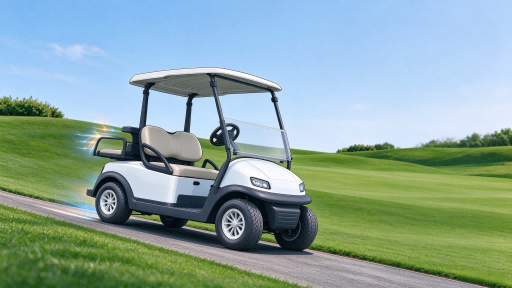
Choosing the best lithium battery for a golf cart comes down to six checks: the right voltage, capacity sized by usable energy rather than lead acid amp-hours, a discharge current rating that covers your hills, a smart BMS with a lithium-specific charger, a physical fit with the right IP rating and certificates, and a supplier who stands behind the warranty. Get those right and a lithium upgrade pays for itself in weight, range, charging time and maintenance savings over the life of the cart.
As a professional LiFePO4 battery manufacturer and supplier in China, we produce 48V (51.2V) golf cart lithium batteries and modular storage packs with Tier-1 cells, smart BMS and full OEM / ODM customization. Tell us your cart model, voltage, terrain and daily rounds, and we will recommend the right capacity and prepare a sample and quotation for you.

Leave A Message
Scan to Wechat :

Hi! Click one of our members below to chat on