
 English

Our team is committed to providing high-performance energy solutions tailored to your needs. To initiate further communication, kindly submit a formal inquiry for the product(s) of your interest.



Our team is committed to providing high-performance energy solutions tailored to your needs. To initiate further communication, kindly submit a formal inquiry for the product(s) of your interest.
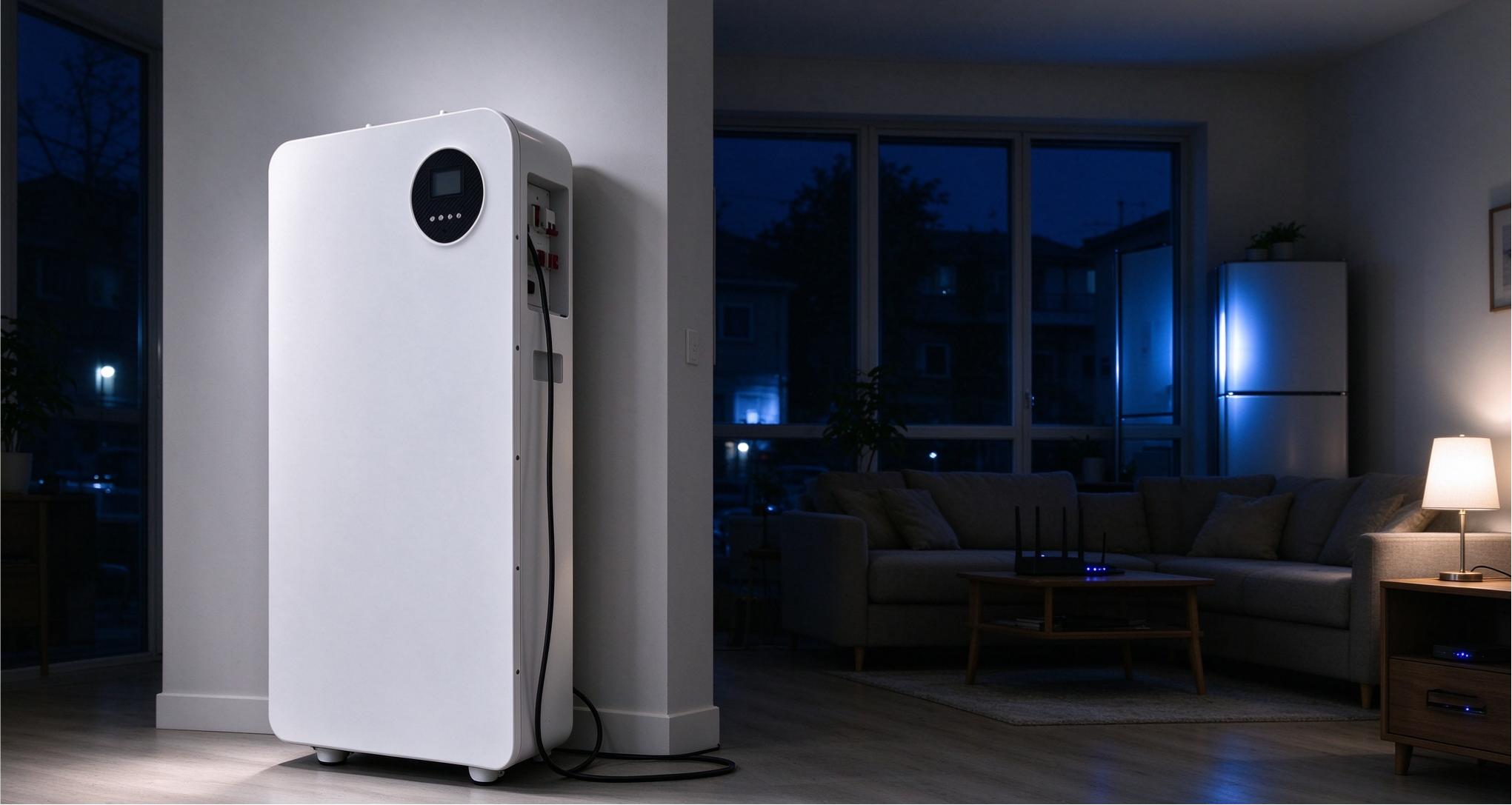
A power outage is not one event. It is a series of small things that happen in a fixed order, and most of them are completely predictable. Knowing the order changes what you prepare — and it explains why some households barely notice an outage while others lose a freezer full of food.
Here is what the first 24 hours look like, hour by hour, with and without a home backup power system in place.
| Time | What happens | With a battery |
| 0 min | Lights go out, the fridge hums to a stop, the router dies | Switches over in about 10 ms — lights barely flicker |
| 10 min | Phone still works but there is no internet; lifts and pumps stop | Internet and Wi-Fi keep running |
| 1 hour | The fridge starts warming; children ask when the power is back | Nothing changes at home |
| 4 hours | After a few door openings, the fridge is close to its safe limit | Fridge runs as normal — it only needs about 1.2 kWh a day |
| 12 hours | It gets dark: torches, power banks, candles | Normal lighting, TV, hot water — depending on capacity |
| 24 hours | Chilled food starts to spoil; a shop loses a day of trade | Still normal; the freezer is still cold |
Opening the fridge to check. Every opening lets the cold air out and speeds up warming. Keep it shut — a closed fridge holds its temperature for about four hours.
Streaming video on the phone. The mobile network may also be running on backup power. Save the battery for messages and calls, and switch on power-saving mode.
Hunting for a torch in the dark. Keep one torch and one power bank in a fixed drawer everyone knows about. A phone flashlight drains the battery you may need later.
In plain terms, a 10.24 kWh system holds about 9.2 kWh of usable energy. That is a lot for some loads and very little for others:
| What you keep on | Daily use | How long it lasts |
| Fridge, lights, router, phones | about 2 kWh | about 4 days |
| Plus TV, laptops, fan | about 3.4 kWh | 2–3 days |
| Plus air conditioning (AC only) | about 11 kWh | 6–7 hours of cooling |
| Water heater, space heater, dryer | 2 kWh per hour or more | Drains it in hours — use sparingly |
One more practical point: high-surge loads such as well pumps, compressors and workshop machines draw several times their rated power for a second or two at start-up. If those must run during an outage, tell your installer in advance — it changes the size of the whole system (inverter/PCS power, not just battery capacity).
By the second half of the day, the inconvenience turns into money. Three places it shows up:
Food. A closed fridge keeps food safe for roughly four hours; a full freezer holds for 24–48 hours, a half-full one about 24. A long outage can wipe out a week of groceries.
A shop's day of trade. Freezers thawing, no lighting, no card terminal, no air conditioning. The lost margin of one trading day usually exceeds the price of the battery that would have prevented it.
Medical and family needs. Oxygen concentrators, infant formula, a bedroom that must stay cool for an elderly parent. These are not comfort loads — they are the reason to size for 24 hours rather than 4.
If you want to prepare for a power outage properly, five small things cover most of it. None of them takes more than ten minutes:
Find out which sockets stay live. With a backup system, only the circuits wired to it keep working. Label those sockets, and plug the fridge and router into them.
Keep the fridge closed. Tape a note on the door if you have children. Every opening costs about 30 minutes of safe time.
Put a torch and power bank in one fixed place. Not "somewhere in the drawer" — one place, everyone knows.
Put medical equipment on its own circuit. Tell the installer before the system is designed, not after. This is the one item that is difficult to change later.
Check the battery once a month. One glance at the app is enough. The worst time to discover an empty battery is the moment the lights go out.
That is the whole power outage checklist. No generator maintenance, no fuel storage, no monthly test run — which is the practical reason many households choose a battery over a generator.
Most of what goes wrong in a 24-hour outage is predictable, and most of it is not about electricity at all — it is about food, communication, and not being able to keep a normal evening. A battery does not make an outage disappear. It makes the first 24 hours look like a normal day, which is usually what people actually want.
We build 10.24 kWh all-in-one systems (LMHCYT4810K) and 5.12 kWh stacked modules (LMHC4805K) for exactly this use — fridge, lights, network and medical equipment first, comfort loads when there is room. Tell us your household, what must keep running, and how long an outage usually lasts in your area.
Q1:How long can this home backup battery run my fridge?
A:Depends on fridge power draw. This 10.24kWh all-in-one unit can run a standard household fridge for roughly 24 hours under normal use.
Q2:Can I expand the battery capacity later?
A:Yes. The 5.12kWh stackable model supports capacity expansion by adding extra battery modules. You can also explore other LiFePO4 lithium battery products for different energy storage requirements.
Q3:Is LiFePO4 battery safe for indoor home installation?
A:LiFePO4 chemistry offers superior thermal stability, suitable for indoor residential use with proper ventilation.
Q4:Does it switch power automatically when blackout happens?
A:Yes. It features seamless automatic transfer, switching within 10ms, no power cut for your connected devices.

Leave A Message
Scan to Wechat :

Hi! Click one of our members below to chat on