
 English
Our team is committed to providing high-performance energy solutions tailored to your needs. To initiate further communication, kindly submit a formal inquiry for the product(s) of your interest.



Our team is committed to providing high-performance energy solutions tailored to your needs. To initiate further communication, kindly submit a formal inquiry for the product(s) of your interest.
Electric forklifts shuttling through warehouses, AGVs running 24/7 between production lines, port RTG cranes lifting heavy loads at dockside—these scenarios share one thing in common: they all rely on continuous power from high-capacity industrial batteries.
But different scenarios have vastly different battery requirements. A warehouse forklift might be fine with a single 8-hour shift, while a port crane demands round-the-clock heavy-duty operation. Under-sizing leads to frequent charging that disrupts productivity; over-sizing strains budgets and installation space.
Likeminded offers three LiFePO₄ battery packs for the 80V industrial platform—280Ah, 330Ah, and 410Ah—corresponding to light, medium, and heavy operating intensities. This article helps you match the right battery to your specific scenario.
Scenario 1: Warehouse Logistics – 280Ah, Just Right for an 8-Hour Shift
Warehouses, distribution centers, and manufacturing shops share typical characteristics: moderate operating intensity, fixed shifts (typically 8–10 hours/day), and equipment dominated by 3–5 ton electric forklifts and small-to-medium AGVs.
The LMDD80V280Ah stores 22.4kWh of energy. Taking an 8kW rated electric forklift as an example, it can operate continuously for approximately 2.8 hours under moderate loads. Combined with fast charging during lunch breaks or shift changes (75A charging current, about 3 hours from 20% to 100% SOC), it can easily support an entire day shift.
Why is 280Ah ideal for this scenario?
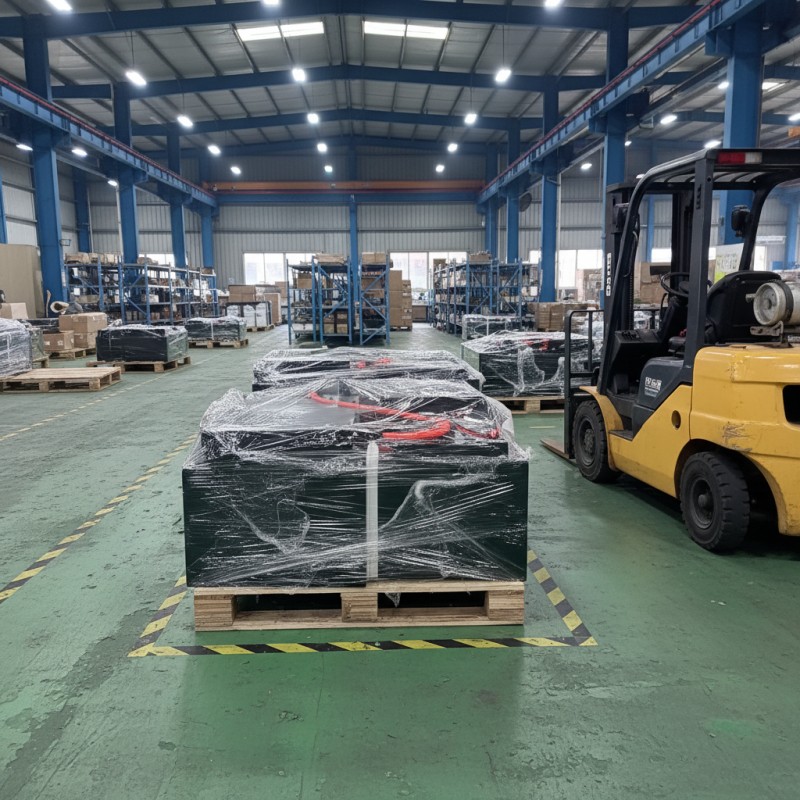
• 22.4kWh precisely covers single-shift requirements without budget waste
• 236kg weight and 1030mm length fit standard forklift battery compartments
• 400A continuous discharge meets the power demands of the vast majority of warehouse equipment
• The best cost-performance ratio and shortest payback period
Applicable Equipment: 3–5 ton electric forklifts, medium-sized AGVs, electric pallet jacks, electric stackers
One-sentence summary: Single shift, moderate load, standard equipment—280Ah is the sweet spot for warehouse applications.
Scenario 2: Factory Campus – 330Ah, Longer Runtime with Lighter Weight
Factory campuses, large manufacturing facilities, and logistics transfer centers involve higher operating intensities, larger equipment (5–8 ton forklifts, heavy-duty AGVs, electric sweepers), and shifts that may extend to 12 hours or even double shifts.
The LMDD80V330Ah stores 26.4kWh—4kWh more than the 280Ah. For the same 8kW forklift, theoretical runtime extends from 2.8 hours to 3.3 hours, adding approximately 30–45 minutes of full-load operation. For scenarios requiring longer shift coverage, this extra capacity can mean the difference between "just enough" and "needs a mid-shift charge."
A detail often overlooked: The 330Ah offers 17.8% more capacity than the 280Ah, yet weighs 16kg less (220kg vs 236kg). This is due to the higher energy density of the IFP58200225-330Ah cells. For weight-sensitive equipment such as aerial work platforms and lightweight AGVs, this 16kg reduction translates directly into increased payload capacity.
Why is 330Ah ideal for this scenario?
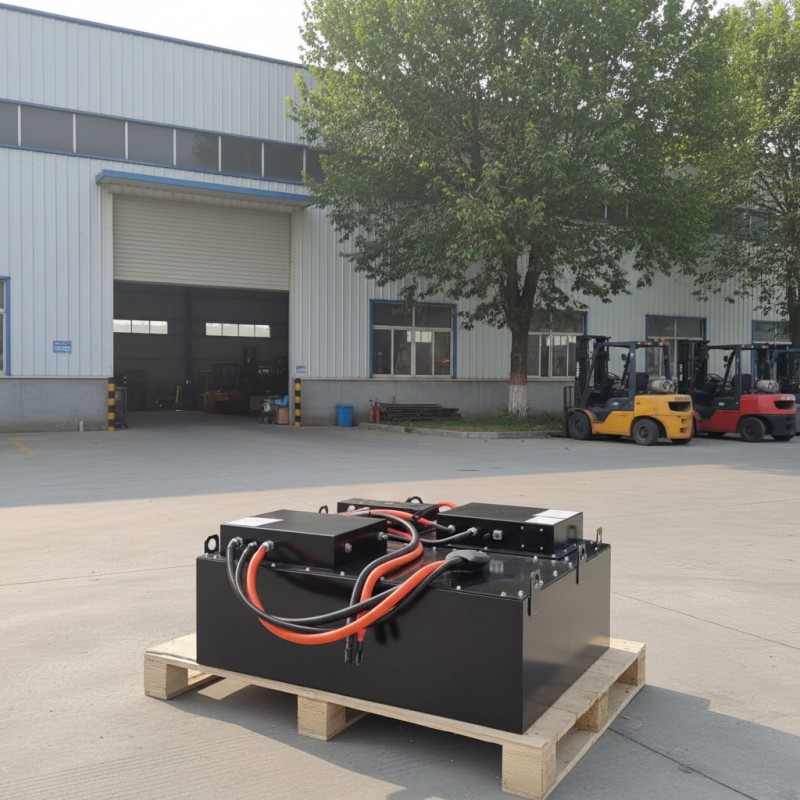
• 4kWh of extra energy extends runtime by approximately 30–45 minutes
• Lighter weight imposes less impact on equipment payload
• 880mm length is 150mm shorter than the 280Ah, offering greater installation flexibility
• Ideal for equipment that needs longer runtime without adding weight
Applicable Equipment: 5–8 ton electric forklifts, heavy-duty AGVs, electric sweepers, aerial work platforms
One-sentence summary: Longer shifts, higher intensity, weight-sensitive—330Ah delivers extended runtime in a lighter package.
Scenario 3: Ports and Docks – 410Ah, 24/7 Heavy-Duty Continuous Operation
Port cranes, mining locomotives, large reach stackers, and heavy-duty AGVs—these machines barely acknowledge the concept of "downtime." Operation is everything; stoppage is loss.
The LMDD80V410Ah stores 32.8kWh—6.4kWh more than the 330Ah—and adopts a 2P25S configuration (2 parallel, 25 series), consisting of 50 cells. For a 22kW rated port crane, a full charge supports approximately 1.5 hours of full-load operation. The charging current is boosted to 200A (compared to 75A for the 280Ah and 330Ah), allowing a 20%-to-100% charge in about 2.5 hours—significantly reducing charging downtime.
Key differentiating advantages:
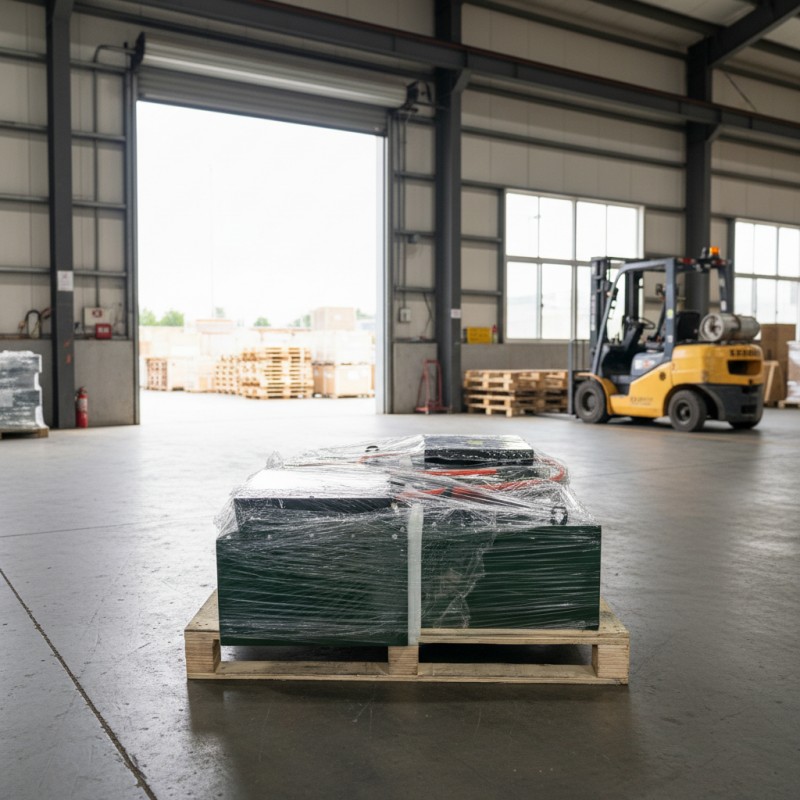
• Significantly higher charging power: 200A charging current cuts charge time to 2.5 hours—a full recharge during a lunch break
• Parallel redundancy: 2P25S configuration ensures that even if a single cell fails, the pack can still operate at reduced capacity for critical operations
• Massive 32.8kWh storage: meets the demands of round-the-clock heavy-load operation
Applicable Equipment: Port RTG cranes, mining locomotives, large reach stackers, heavy-duty AGVs, high-power loaders
One-sentence summary: 24/7, heavy load, zero downtime—410Ah is the power foundation for heavy equipment.
Quick Reference Selection Guide
| Dimension | 280Ah | 330Ah | 410Ah |
| Operating Intensity | Moderate | Medium-High |
Heavy |
| Daily Runtime | ≤8 hours | ≤12 hours |
24/7 |
| Typical Equipment | 3-5t forklifts, mid-size AGVs | 5-8t forklifts, aerial platforms |
Port cranes, mining locomotives |
| Total Storage | 22.4kWh | 26.4kWh |
32.8kWh |
| Charge Current | 75A | 75A |
200A |
| Full Charge Time | ~3h (20%-100%) | ~3h (20%-100%) |
~2.5h (20%-100%) |
| Weight | 236kg | 220kg |
330kg |
| Dimensions (L×W×H) | 1030×480×387mm | 880×480×387mm |
975×460×649mm |
| Best Fit | Standard single-shift | Extended shifts / weight-sensitive |
24/7 heavy-duty |
Selection Summary: Calculate First, Then Match Your Scenario
Three steps to quickly zero in on your target capacity:
Step 1: Calculate equipment rated power (kW) × daily operating hours (h) = daily energy consumption (kWh)
Step 2: Based on a recommended 80% depth of discharge, required battery capacity ≈ daily energy consumption ÷ 80%
Step 3: Compare against the three options (22.4/26.4/32.8kWh) and select the smallest capacity that exceeds your calculated requirement
Example: A 16kW machine operating 6 hours per day consumes 96kWh daily → required capacity ≈ 96 ÷ 80% = 120kWh → three 410Ah packs in parallel (32.8 × 3 = 98.4kWh, still short) → four packs (32.8 × 4 = 131.2kWh, sufficient). Parallel configurations require Likeminded engineering review.
Final Recommendation:
| Runs a single 8-hour shift with moderate loads | 280Ah – best value, fastest payback |
| Runs extended shifts and weight is a concern | 330Ah – more capacity, less weight |
| Runs 24/7 heavy-duty with zero tolerance for downtime | 410Ah – maximum capacity, fastest charging |
For detailed technical specifications or a customized battery solution tailored to your specific equipment and duty cycle, contact the Likeminded technical team for a professional site assessment and system design consultation.
FAQ
Q1: Why does the 330Ah weigh less than the 280Ah despite having more capacity?
The 330Ah uses IFP58200225-330Ah cells with higher energy density, achieving greater capacity in a lighter cell design. This is a key advantage of LFP technology advancement—more energy, less weight.
Q2: Can I parallel multiple packs for even larger capacity?
The specification explicitly states that series connection is not supported. Parallel configurations require customized BMS strategy validation—do not attempt to parallel packs without engineering review. For larger capacity needs, contact Likeminded engineers to evaluate a parallel solution.
Q3: What's the difference between 1P25S and 2P25S configurations?
1P25S means 25 cells in series, 1 parallel branch—25 cells total. 2P25S means 25 cells in series, 2 parallel branches—50 cells total. The parallel branches share the load, providing redundancy and higher total capacity.
Q4: How do low temperatures affect runtime?
LiFePO₄ cells have reduced activity at low temperatures, so range will decrease accordingly. The BMS automatically adjusts undervoltage protection thresholds from 2.8V down to 2.4V when the minimum cell temperature falls below 0°C, unlocking additional available capacity to maximize winter range. For extended cold-weather operation, consider adding a heating insulation module.
Q5: How are the warranty period and cycle life calculated?
All three models offer a 3-year warranty from the date of manufacture, with charge-discharge cycle life ≥1,200 cycles—whichever comes first. Damage caused by improper use (e.g., overcharge, over-discharge, short circuit, water ingress, physical damage) is not covered under warranty, even within the 3-year period.

Leave A Message
Scan to Wechat :

Hi! Click one of our members below to chat on