
 English

Our team is committed to providing high-performance energy solutions tailored to your needs. To initiate further communication, kindly submit a formal inquiry for the product(s) of your interest.



Our team is committed to providing high-performance energy solutions tailored to your needs. To initiate further communication, kindly submit a formal inquiry for the product(s) of your interest.
If your warehouse runs multi-shift electric forklifts and suffers from frequent power shortages, high maintenance costs and unstable discharge performance, 80V 25S LiFePO4 battery packs (330Ah & 410Ah versions) are the ideal energy upgrade solution. Industrial lithium battery packs adopt maintenance-free design, stable high-current output, over 1200 charge cycles and full intelligent BMS protection, which can effectively cut long-term operation costs for logistics warehouses.
Key Takeaways
1. Two mainstream capacity options: 80V 330Ah (220kg) fits single and double-shift medium-load operations; 80V 410Ah (330kg) supports 24-hour continuous heavy-duty lifting work.
2. Built-in DTU-equipped BMS realizes multi-channel CAN communication, real-time fault reminder and remote real-time monitoring of battery operating data.
3. LiFePO4 material has outstanding thermal stability, complying with GB/T36972-2018 national battery safety standard and RoHS environmental protection requirements.
4. Standard 3-year warranty (excluding leasing batteries), with three-level fault early warning and cut-off mechanism to prevent thermal risks under extreme working conditions.
Pain Points of Lead-Acid Batteries in Multi-Shift Warehouses
Traditional lead-acid batteries have long been the standard power source for forklifts, yet they cannot match the high-intensity operation needs of multi-shift logistics warehouses.
• Long full charging cycle: It takes 8 to 10 hours to fully charge, making shift battery replacement inevitable and wasting labor and equipment waiting time.
• Cumbersome daily maintenance: Regular water replenishment, electrolyte detection and acid corrosion cleaning are required, adding extra labor costs every month.
• Short service life: Only 500–800 charge-discharge cycles, sulfation failure easily occurs under incomplete charging, leading to frequent battery replacement.
• Poor high-current stability: Serious voltage drop during heavy lifting, slowing down forklift operating efficiency.
The 80V 25S LiFePO4 forklift battery perfectly addresses all the above drawbacks and becomes a reliable power solution for high-frequency multi-shift warehouses.
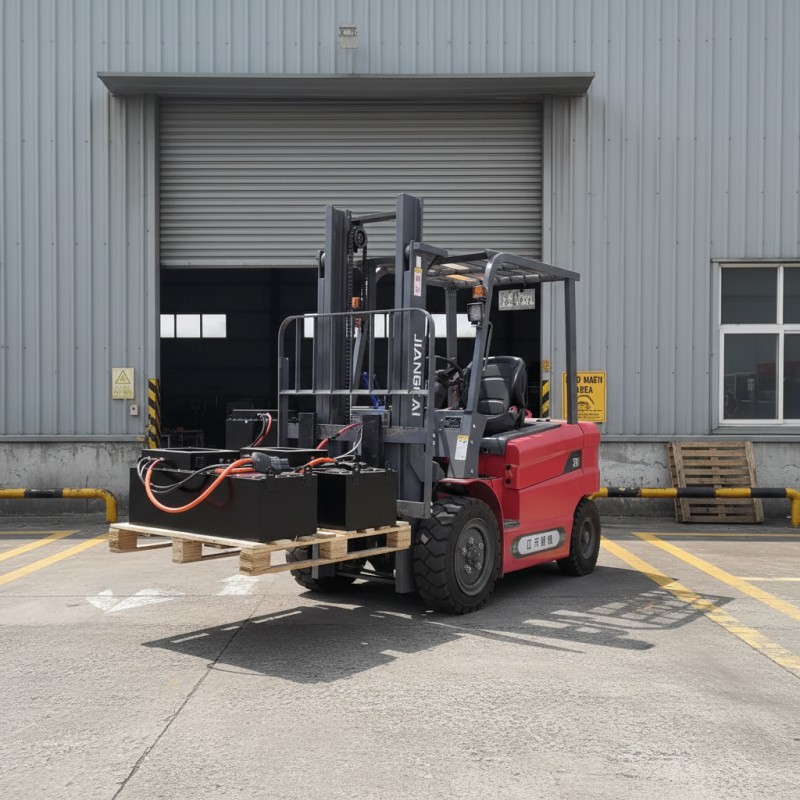
Maintenance-free design: No water filling, electrolyte inspection or anti-corrosion cleaning required.
Support opportunity charging: Short supplementary charging during staff breaks will not damage cell life, eliminating the need for spare battery groups.
Energy efficiency up to 95%, much higher than the 75% efficiency of lead-acid batteries, saving daily electricity consumption.
Stable 91.25V nominal voltage, no obvious voltage sag even under peak 450A discharge current.
Safe cell material: No flammable gas generated during charging and discharging, lowering fire risks in charging areas.
Two Mainstream 80V LiFePO4 Battery Specifications For Forklifts
There are two mature 25-series 80V lithium battery configurations on the market, customized for different daily operation intensities of warehouses.
80V 330Ah Lithium Battery
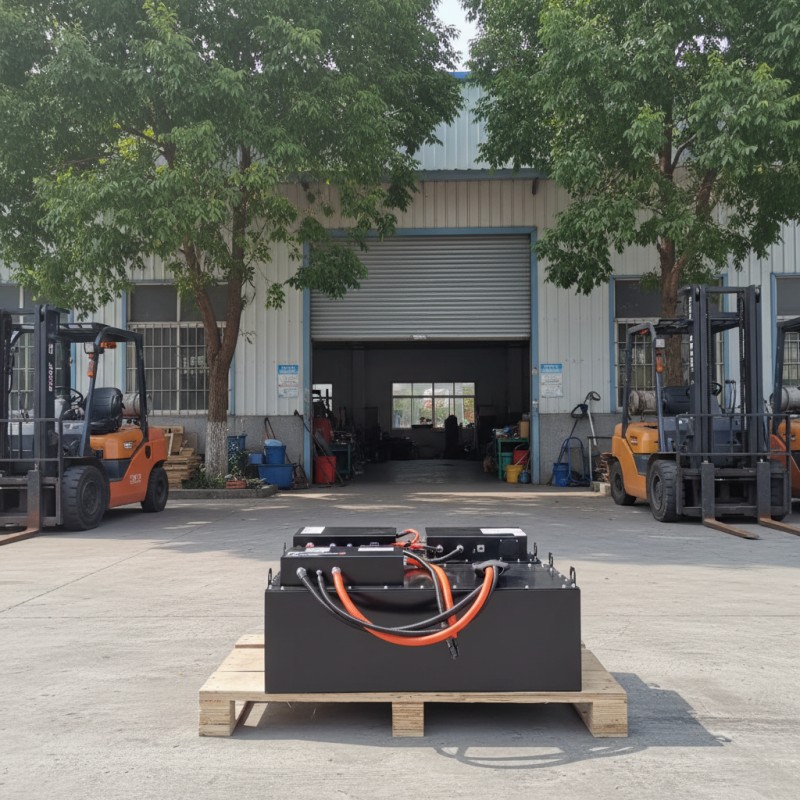
Cell layout: 1P25S LFP cells
Overall dimension: 880±2mm × 480±2mm × 387±3mm
Gross weight: 220±5%kg
Matching cable & plug: 35mm² charging cable, 50mm² discharge cable with REMA160A connector
Applicable scenarios: Single-shift and double-shift medium-load forklifts, stacking trucks, light port handling equipment
80V 410Ah Lithium Battery
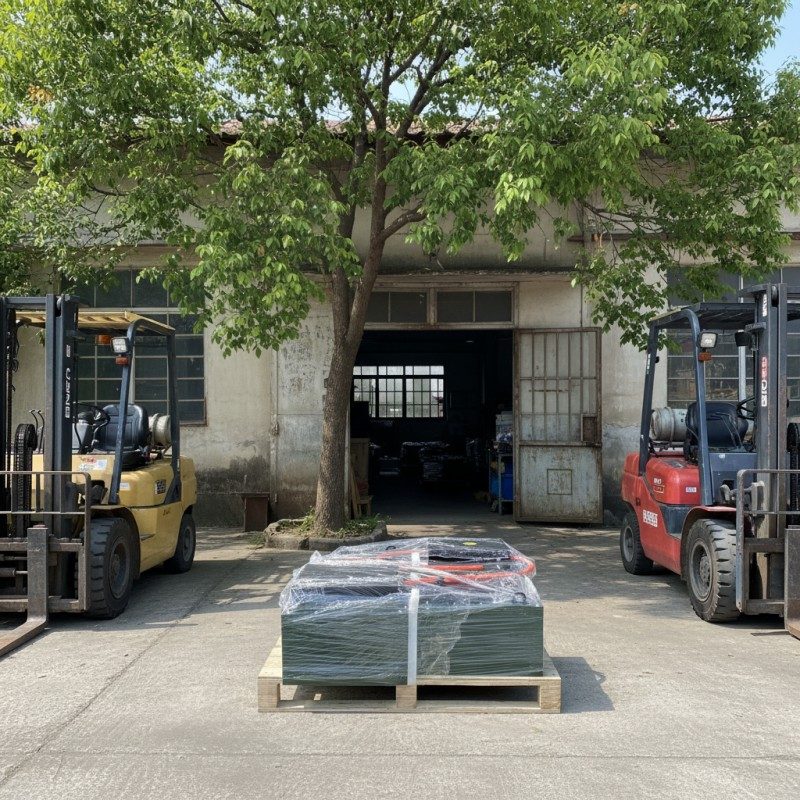
Cell layout: 2P25S LFP cells for stronger continuous current output
Overall dimension: 975±2mm × 460±2mm × 649±3mm
Gross weight: 330±5%kg
Matching cable & plug: 50mm² charging cable, 70mm² discharge cable with REMA320A high-current connector
Applicable scenarios: 24-hour triple-shift heavy forklifts, cold storage handling vehicles, large container transport trucks
Both battery versions integrate intelligent BMS with DTU module, supporting three sets of independent CAN communication channels for internal battery, charging and whole-vehicle connection, which can upload real-time data including voltage, temperature and SOC to the remote backend.
Multi-Layer Safety Protection System Of 80V Industrial Lithium Batteries
The built-in BMS divides all abnormal working states into three fault levels with independent delay release logic, covering 35 common abnormal conditions to avoid sudden power failure during cargo lifting.
• Level 1 Minor Fault: Only trigger alarm without power cut, including low SOC, slight temperature imbalance, mild voltage inconsistency.
• Level 2 Medium Fault: Limit charging/discharging power to protect cells, such as overcharge, over-discharge, medium temperature abnormality.
• Level 3 Severe Fault: Directly cut off relay for emergency protection, including over-current, extreme high/low temperature, insulation failure.
Key safety parameters for reference
• Max continuous discharge current: 420A; peak short-time discharge up to 460A
• Working temperature range: Discharge -5℃ ~ 55℃; charging only allowed within 0℃ ~ 35℃
• Insulation protection threshold: Warning at 500Ω/V, emergency power cut below 100Ω/V
Practical Cost Saving Case for Multi-Shift Logistics Warehouses
A large e-commerce logistics park replaced traditional lead-acid batteries with 80V 410Ah lithium battery packs in early 2026. After half a year of operation, obvious cost reduction effects were recorded:
• Labor cost reduction: No full-time staff needed for daily battery maintenance, saving the salary of 1-2 workers every month.
• Electricity consumption saved: High energy efficiency cuts overall power usage by around 20%.
• Zero waiting downtime: Opportunity charging eliminates the time wasted on replacing spare batteries between shifts.
• Safety cost optimization: No acid leakage and hydrogen gas, no extra ventilation and anti-corrosion renovation for charging rooms.
Nowadays, more and more multi-shift logistics warehouses abandon traditional lead-acid batteries and choose 80V LiFePO4 forklift batteries to cut comprehensive operating costs. The two capacity versions of 330Ah and 410Ah cover light, medium and heavy-duty logistics scenarios, equipped with intelligent remote monitoring and multi-level safety protection. If you need customized size, plug interface or heating function to fit your forklift fleet, customized battery solutions can be provided.
FAQ
Q1 Can I charge the 80V lithium battery with a lead-acid charger?
A1 Absolutely not. You must use a special charger matched for LiFePO4 with 87.5V cut-off voltage. Mismatched chargers will trigger overvoltage faults and permanently damage the BMS protection board.
Q2 Is it allowed to connect multiple battery packs in series or parallel?
A2 For safety considerations, single 25S 80V battery packs cannot be connected in series or parallel. Independent single-pack design avoids voltage inconsistency risks between multiple groups.
Q3 How to use the battery normally in cold storage below 0℃?
A3 The battery supports discharge under -5℃ low temperature, yet charging below 0℃ will trigger low-temperature fault and limit charging power. For long-term cold storage application, a heating module can be added as an optional accessory.
Q4 Does the built-in DTU module support overseas remote monitoring?
A4 Standard DTU modules come with domestic data traffic; international upgraded DTU versions are available for overseas users to realize real-time remote monitoring abroad.

Leave A Message
Scan to Wechat :

Hi! Click one of our members below to chat on